Technology
Recommend this page to friend Recommend this page     Print Print
 

Accelerometers

Technology 


Noliac's piezoelectric vibration sensors type MH and ME are intended for general use in systems for vibration measurements and machine condition monitoring.


They feature low sensitivity to temperature and magnetic field fluctuations, low transverse sensitivity, high resonance frequency and high stability. The internal system is designed as a shear type with Ring Shear® construction (patent pending). The measuring value is acceleration in sensor's axis direction.


The sensor's external casing is made of stainless steel. A coaxial connector with 10-32 UNF thread is used for the outlet. The active element of the sensor is a shear stressed piezoelectric ring. Compensation of primary pyroelectric charge is guaranteed through a special system of electrodes in the piezoelectric sensor and their suitable interconnection. Seismic mass and dimension of the piezoelectric element is selected in order to achieve good sensitivity and high resonance frequency and sufficient shock resistance. The sensor is attached to the measured object with a metric screw (UN threads on request).


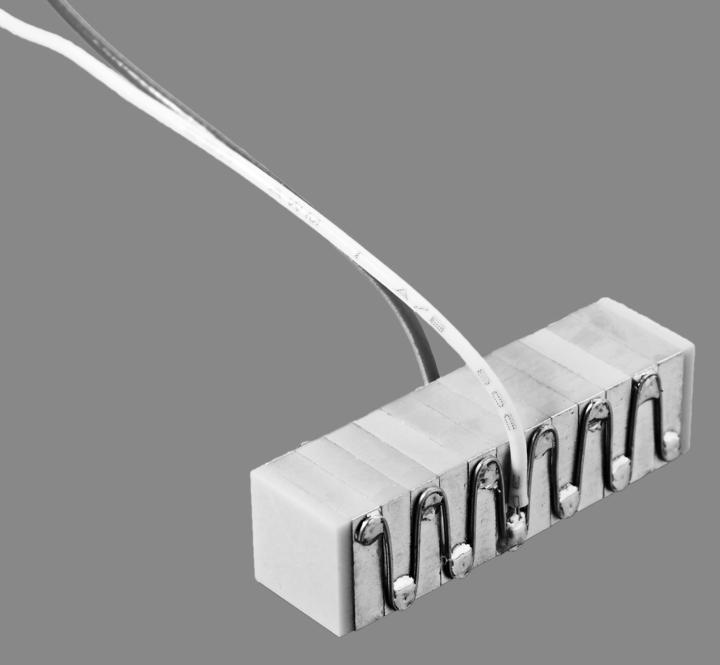
Typical sensor design

Ring shear type sensor


Assembly and application instructions

The ring shear type sensors are intended for permanent or temporary assembly on measured objects. Use a spanner to attach the sensor with a metric screw.


Select the place of vibration measurement to avoid influence of a strong magnetic field or rapid temperature variations. The dynamic deformation of the base should be as low as possible.


Apply silicone grease on contact area before the sensor is attached onto the measured surface. The grease will guarantee undisturbed transmission of vibrations into the sensor even at high amplitudes and high frequencies.


Only viscous forces are able to transmit action of the sensor's inertial mass force. We recommend use of a measuring tip or a magnetic clamp for short time and informative measurements only.
 

Capacity temperature characteristics

Capacity temperature characteristics


Charge sensitivity versus temperature characteristics

 Charge sensitivity versus temperature characteristics


More information

Please contact:

Noliac Systems

systems@noliac.com


Did you find what you were looking for? If not, try our custom products.


Custom products


Request for quote


Newsletter


Related links
© Noliac A/S 2008 - All rights reserved - T: +45 4912 5030 - F: +45 4912 5031 - info@noliac.com