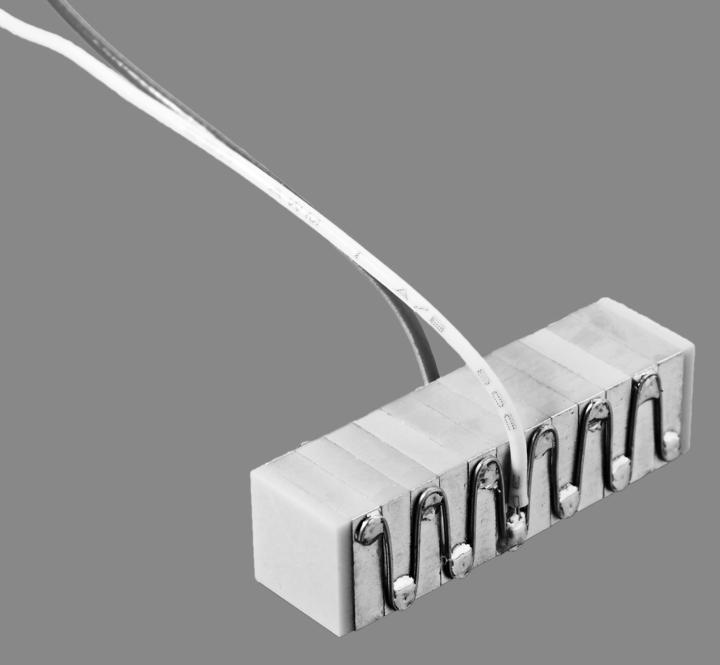
Piezo sensors
Technology
Piezo sensors are used to convert mechanical movements, such as force, acceleration or pressure, into electric signals.
Apart from classical vibration recorders to detect imbalances of rotating machine parts or in crash detectors in the automotive industry, they are being used more and more in ultrasonic level measurement and flow rate measurement applications.
There, for example, the propagation time of the reflected echo of an ultrasonic wave is evaluated. Flow rate measurements are based on propagation time measurements or on the Doppler effect (measurement of phase difference). Further typical applications of “soft“ piezo ceramics are to be found in object identification and surveillance (e. g. surveillance sensors for cars, glass tampering detectors, etc.), sound transmitters (buzzers) and sound receivers (microphones), to their use in the sound pickups of musical instruments.
Axial and bending sensors
When speaking of piezoelectric sensors, it is necessary to distinguish between the axial sensor and the bending sensor. Axial sensors are subjected to a force in the polarization direction (33 mode) whereas the force on bending sensor is being exerted perpendicular to the polarization direction (31 mode).

Axial sensors can either be made from bulk material (single layer) or from multilayer (cofired component), where the latter introduces new options such as active feedback mechanisms serving the aim to constantly monitor the functionality of the sensor.
Bending sensors are commonly made as bulk or bimorph. Noliac bimorphs are co-fired structures where the middle electrode is screen-printed in the green state (unfired ceramic) and the external electrodes are applied after firing. Bimorphs can be polarized either in series or parallel, depending on customer requirements.

Multilayer bending sensors (more than 2 active layers) with similar build-up structure as bending actuators are also available.
|