|
|
|
|
Accessories
Noliac develops different kinds of accessories for their standard products.
|
|
|
| |
Coating
Noliac have been running preliminary investigations of different coatings.
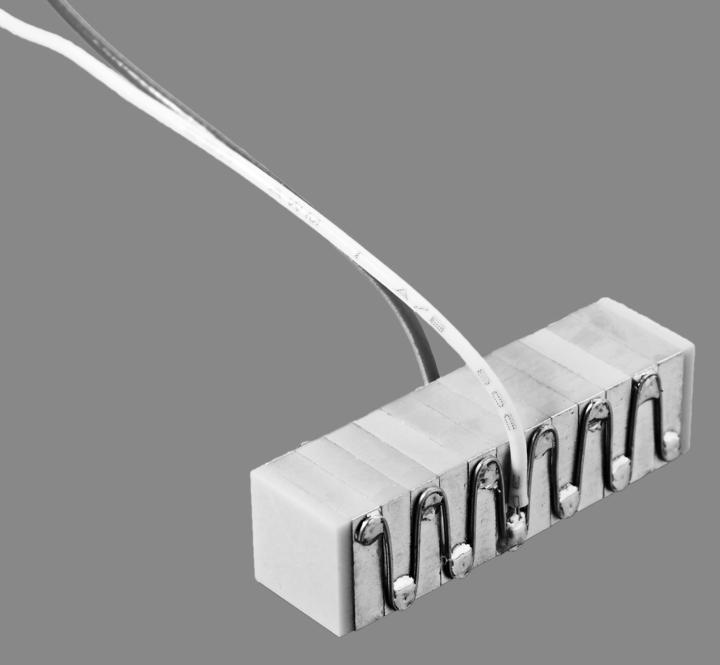
Polyurethane lacquer can encapsulate the electrodes entirely and thus prevents any electrical short circuit upon inserting the actuator in e.g. a metal tube with tight margins. The lacquer provides very good reliability properties and is sufficiently flexible to allow full actuator movement without any decrease of strain.
Furthermore, an epoxy coating has been evaluated, which seals the component even better, as the method of applying the coating is performed via the so-called fluidized bed technique. The piezoelectrical actuator is heated up and inserted into a mist of epoxy powder, which makes the powder melt onto the actuator. The endplates are masked before the process to ensure that no coating is applied here. Despite the rather stiff epoxy coating, properties of the piezoelectric stack are not affected negatively.
The coatings are not offered as standard to Noliac stacks, but could be considered for certain customized products, where the improved properties by a coating are attractive. More information can be given upon request.
|
|
|
| |
|
Strain gauges
Noliac has developed know-how about the use of strain gauges as a feedback system. Strain gauges give the best results for applications where the force generated by the piezoelectric element is constant or linear with the displacement. The surface of our actuators can be prepared for the application of a strain gauge.
Preparation of the piezoelectric element
The surface where the strain gauge is to be applied should be smooth. For SCMAs, a standard lapping (performed by Noliac as an option) is recommended. After this operation, the piezoelectric element shall be cleaned thoroughly using purified acetone on a clean cloth.
Choice of strain gauge
The strain gauge must cover a sufficient area of the piezoelectric element. Too small measuring systems can be affected by noise or uneven loading. The nominal resistance and electronics must take into account the heat generation of the strain gauge. A 350 Ohms strain gauge with a 2,5V, 5 kHz carrier frequency system is in general appropriate. For example, tests were performed on a stack 5x5x26 equipped with a LY11-3/350 from the HBM range.
Installation
For the installation of the strain gauge, Noliac recommends the following parameters (on NCE57 and NCE46 elements):
- Adhesive: an epoxy paste (such as HBM EP250) is appropriate
- Curing profile for EP250: 1 hour ramp to 120ºC, 5 hours dwell time, 1 hour ramp down to ambient temperature. Make sure that all the components (especially wires) are compatible with this temperature. The piezoelectric component should be short-circuited during this operation.
- The recommended bonding pressure is 10 to 20 N/cm2. The strain gauge should be pressed with a teflon foil (to prevent adhesion) and a layer of rubber material (to even the load). Bending stresses in the ceramic must be avoided.
It is recommended to run some stress cycles on the strain gauge before precise measurements are taken.
|
|
|
|
|
More information
|
Please contact:
Sales
Tel.: +45 4912 5034

|
Did you find what you were looking for? If not, try our custom products.


|
| |
|
Related links
|
|
| | | | |